
When you read widely, deeply, and consistently over time, you will naturally discover your own foundations of knowledge.
If the streets of Saigon reveal a confidence in Southern Vietnamese modernist architecture, the story does not end there. Behind these buildings lies a deeper shift in how architects think, learn, and respond to their time. Architecture, after all, is never just about form—it is shaped by the age it belongs to. In conversation with Mr. Mel Schenck, this chapter steps back from the streets to look at the intellectual landscape that frames architectural practice today. From historical transitions to the Information Age, it explores how ways of thinking change—and why seeing architecture as a whole, rather than a collection of parts, matters more than ever.
What do you find special about young architects in Vietnam today that inspires your vision of holistic architecture in the future?
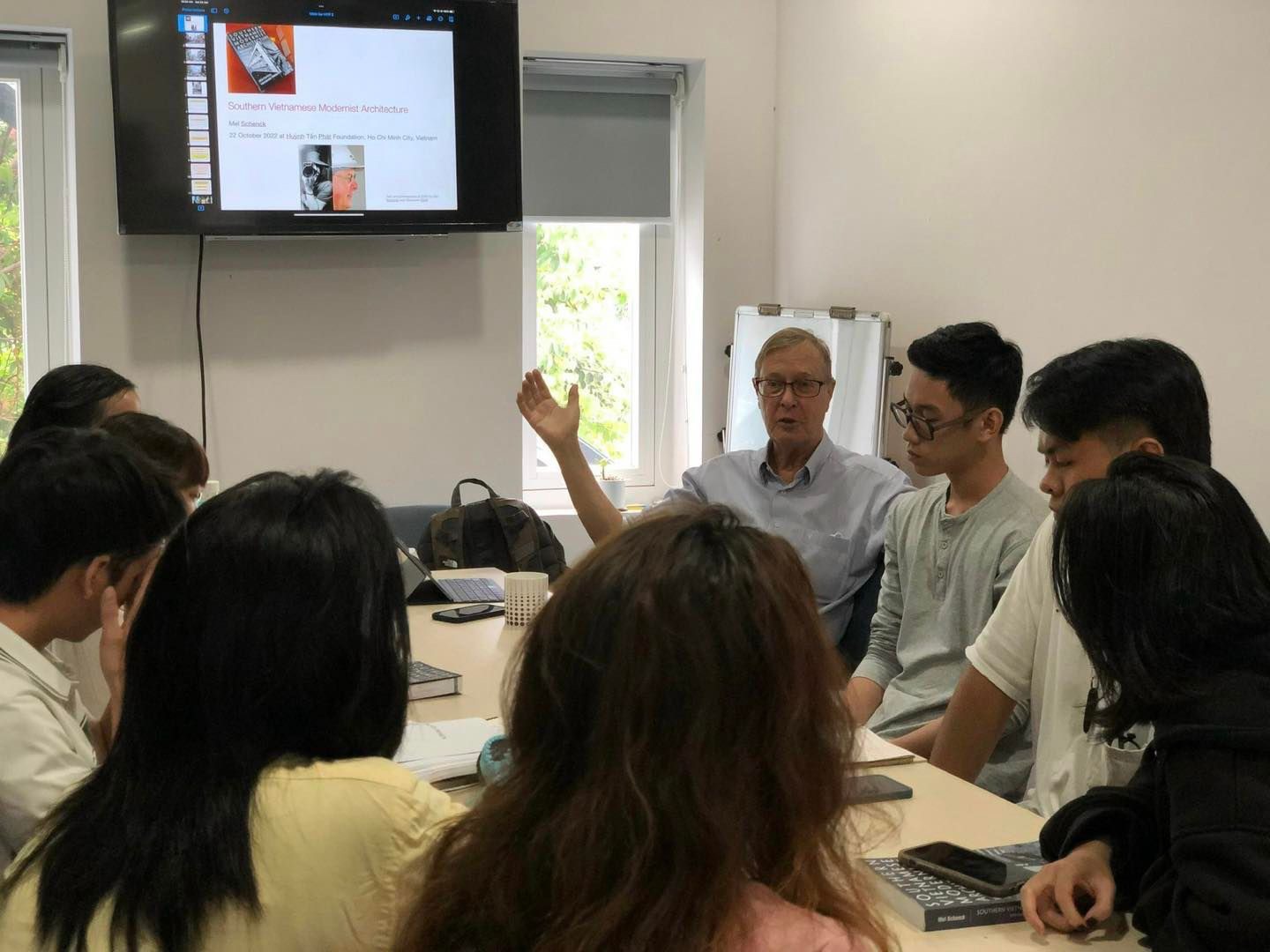
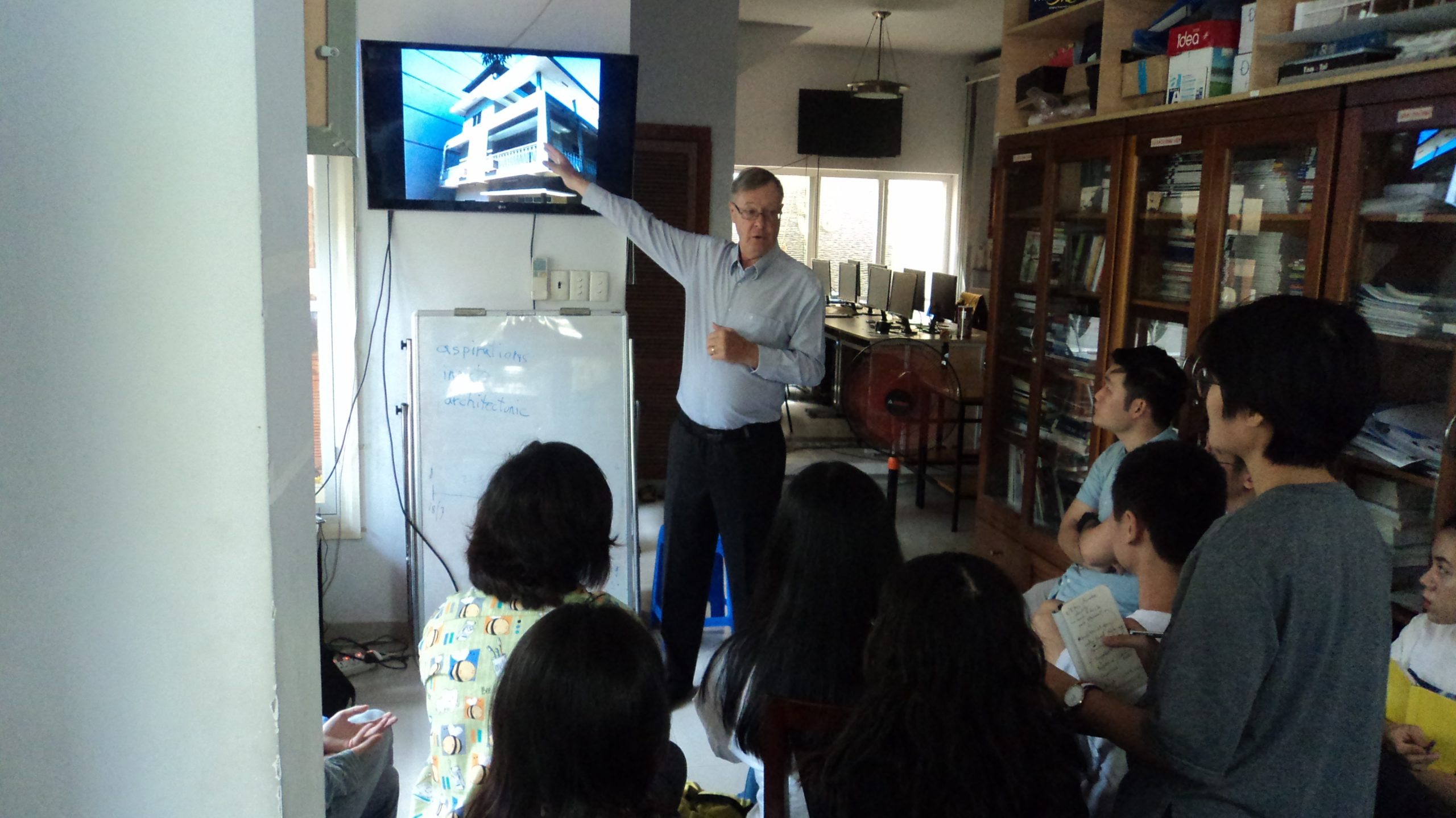
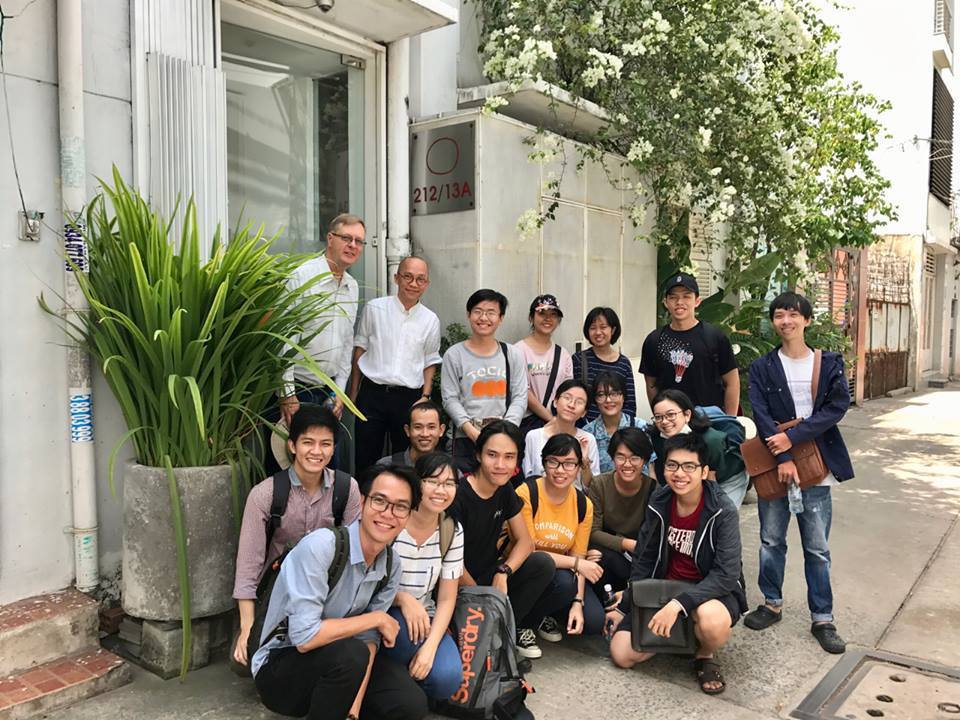
I’m very interested in young architects today. One thing I didn’t mention earlier is that I taught and led seminar classes for the Huynh Tan Phat Foundation for ten years, which I really enjoyed. The classes usually had about twelve to fifteen students per semester. The students were tested to ensure they had at least a medium level of English. They chose topics, did some research, and prepared PowerPoint presentations.
Each class, one or two students would give a presentation in English and then answer questions in English. Answering questions in English requires a lot of effort. I understand that very well. I also gave a couple of presentations each semester—one on modernist architecture and one on holistic architecture. That experience was very important to me because I love teaching. I decided long ago not to go into academia because I wanted to practice architecture, something I had wanted to do since I was ten years old.
Working with the Huynh Tan Phat Foundation gave me the opportunity to teach while still being connected to practice. I love working with students. Whenever a student wants to meet with me to discuss anything, I’m always willing to do so. It’s always interesting because I learn a lot from students as well.
What is your opinion on scientific research conducted by students today? What advice would you give to students regarding academic research?
My question is: why? Architecture is not a science.
There was a period in the 1970s and 1980s when some architects and architecture professors believed that architecture should become more scientific. They even formed a group called the Scientific Methods Group for Architecture. But it didn’t work.
Of course, architects need to understand physics and chemistry to some extent, especially physics. We also need to understand statics and dynamics, and what structural, electrical, and mechanical engineers are doing. Architecture education is broad, and we learn a lot of technical knowledge in school.
However, the most important course in architecture school is design. That’s what most students want to do—to become designers. Design is not just a product, it is a process. In reality, most architects do not become designers. I was good at management, so I became a manager of the design process throughout my career. But I could still design and influence design decisions.
My knowledge of science was sufficient for the work I did, and it is sufficient for most architectural work today. If an architect is involved in highly technical projects, such as advanced data centers, there are always consultants who can provide expertise. When professors emphasize science too heavily, I become concerned. It didn’t work in the past, and it won’t work now. Architecture is architecture, and we need to focus on being good architects.
When I discuss science in my new book, I’m referring to science as it relates to worldview — how scientific thinking has shaped the Information Age. Science has influenced how we understand reality and how we see the world as a whole. In the Information Age, the intellectual force pushes all disciplines to consider systems and wholes rather than isolated parts. I study scientific and philosophical literature to understand how we arrived at this point.
Learning new things is important to me. As long as I’m learning, I feel alive. I still enjoy giving presentations to students at universities and foundations. If you ever want me to speak about holistic architecture at the Huynh Tan Phat Foundation, I would be happy to do so.
What documents or resources do you consider valuable for architecture students today? You know that there are vast documents right now talking about architecture. So what do you think is a good document? What are good documentary resources?
There are so many. I’ve got a bookcase here full of them. So I think it’s important for young architects—and they’re probably not learning this right now—but it’s important to understand the context in which society operates. Whether you’re in America or in Vietnam, there is a context in which we operate, and that context right now is the Information Age.
So it’s important to do something that helps give a sense of the Information Age. The book that is primary to me is called The Third Wave by an author named Alvin Toffler, who also wrote a book called Future Shock. The Third Wave explains that there were three major ages in history. In prehistoric times, people didn’t write things down, but history began when people started recording ideas, or at least transmitting them orally.
The first age, which covers more than half of recorded history, is the Agricultural Age. The Agricultural Age was all about absolutism, and most governments or societies were feudal. There was were kings. There were pharaohs. Governments were not democracies. Religion became the primary force of the Agricultural Age.
No matter which religion, religion was the dominant force — here in Vietnam and around the world, especially in Europe with Christianity. Religious leaders, to a large degree, governed societies. They provided morality, laws, the Ten Commandments, and so on. The Agricultural Age had a very clear intellectual force: absolutism, law, and religion.
When you look at the architecture of that period, you see exactly that. The classical architecture we study is primarily religious — temples in Greece, temples in Rome, along with some government buildings. Gothic cathedrals throughout Europe were religious structures. So the intellectual force of the Agricultural Age, as expressed through architecture, was religion.
The Industrial Age disrupted all of that. During the Agricultural Age, people believed — through religion — that the sun revolved around the Earth, with God at the center. The sun, the moon, and the planets were thought to revolve around the Earth, kept in motion by God. Everyone believed this; it was their sense of reality.
But around 1600, with the beginning of the Renaissance and later the Age of Enlightenment, scientists discovered that the Earth is a planet that revolves around the sun, along with other planets. This realization upset everything. People’s sense of reality changed.
In the Industrial Age, thinking shifted toward parts. New materials — eventually reinforced concrete and steel — emerged and allowed modernism to flourish. Religion became less dominant. Government, industry, companies, and corporations became more important.
Then, around 1900, with Einstein’s theories of space-time, everything was disrupted again. We realized that we had to look at things as a whole. Quantum physics introduced extraordinary changes in how reality was understood. This shift led to where we are now, in the Information Age, where the intellectual force pushes us to see things as wholes rather than isolated parts.
So what was your original question? What do I think is a good book? That’s why I recommend The Third Wave. It defined all of this for me. I already knew much of it, but the book helped confirm what I needed to understand going forward. It has nothing directly to do with architecture, but it helps explain the broader context.
Now, how do young students define which sources contain false information and which contain reliable knowledge when choosing what to read?
If you develop this critical capacity, you can begin to distinguish bad information from good information.
Well, nobody really knows. It’s one of the major problems in society today. How do you separate misinformation from good information?
In the end, everyone has to figure that out for themselves. Through good education, you develop a critical mind—the ability to question what is being said, to question what you see, and to ask why things happen. If you develop this critical capacity, you can begin to distinguish bad information from good information.
If you’re still looking for a single document, I don’t think there is one. All architects are different. All students are different. They have different interests and influences, depending on where they grew up and what their families are like. So there isn’t one definitive document, especially in architecture. Just read as much as you can. Read about Frank Gehry. Read about Zaha Hadid. Check ArchDaily every day. Read about what’s happening in architecture. Sometimes you’ll find articles about Vietnamese architects. A few years ago—was it Dezeen or Architizer? I can’t remember which one — listed the twenty most influential women architects in the world. Le Anni of KIENTRUC O Architects was one of them.
So, for me, it’s important to read as widely as possible. Eventually, you’ll find certain documents that you continue to return to, documents that shape your own sense of architecture. I’m too far removed now from architectural practice and business to say exactly what that should be.
So what do you expect from the audience who read your book?
I see the two books differently. For the modernist book, my audience was Vietnamese students, because they can learn the lessons of heritage architecture that needs to be protected and take that understanding back to their parents. When the book was published in Hanoi, it was in English, and I wanted it to be in Vietnamese. But many students were still able to buy it and help spread the message. I gave many presentations to raise awareness of how important this modernist architecture is, not just here but globally.
I also wanted the book to enter architecture libraries around the world, and that is happening. The message about this architecture—some of the best in the world—is getting out.
It will be the same for the holistic architecture book. The sooner it can be translated into Vietnamese, the better. In the meantime, it will be published in English internationally. One audience I want to reach is architectural historians who don’t yet understand what’s happening here. They are too focused on details and missing the big picture. I even see this in academic writing. I read many journal articles from Europe and America every week, and most scholars still don’t get it. They don’t understand it yet. So I want to put these ideas out into the world.
Through the classes you’ve taught before, what skills and requirements do you think students need in order to be international in the future?
First of all, the purpose of the seminars was to learn the language and vocabulary of international architecture, planning, and design. Most students in Ho Chi Minh City will eventually work on international projects. They may work for Vietnamese firms collaborating with foreign designers. Vietnamese architects will often be responsible for figuring out how buildings are constructed and documented. At some point, they will be working in English.
They may also go abroad for education in Europe or America — though I don’t recommend America at this point — or work for international firms, perhaps in Singapore or elsewhere. There is a high likelihood that architecture graduates here will be involved in international work, because Vietnam is a hub and one of the fastest-growing countries in the world. People are coming here with major projects, and they’re no longer doing them in America.
Presentation skills are also crucial. Students give many presentations at university, but there are fine points to presenting to professional audiences and clients that are often not taught. Students usually learn by doing, which is valuable, but I try to explain specific techniques that can significantly improve their presentations. So the experience of presenting is a major part of the class. I hope students leave with better presentation skills, more confidence in presenting, and greater confidence in their English abilities—both in interpreting ideas and presenting them to professors.
 English
  Vietnamese